
Choosing curtains often begins with colour, print, texture and fabric. You may spend days comparing solids, sheers, florals or textured cotton curtains, only to realise after installation that the length changes everything. A curtain that is too short can make a room look unfinished. One that drags too much may collect dust, get caught near a balcony door or become difficult to manage every day.
This is why floor length curtains are such a popular choice for Indian homes. They make rooms look taller, give windows and doors a complete frame, and create a more intentional finish. Still, they are not the only option. In kitchens, study corners, compact windows or homes with heavy daily use, shorter curtains or Roman blinds may work better.
The Yellow Dwelling’s Expert Home Visit can also help when you are unsure about curtain length, fabric fall or measurements, especially for custom curtains and Roman blinds.
What Does “Floor Length” Actually Mean?

“Floor length” is often used loosely for any curtain that reaches the lower part of the wall. In actual use, a true floor-length curtain usually ends just above the finished floor or lightly touches it without visibly folding. It should look intentional, not like the curtain was cut a little too short or allowed to collapse at the bottom.
The measurement should always begin from the actual hanging point. This could be the curtain track, the ring eye, the rod position or the final header style. Measuring only from the top of the window frame can lead to the wrong drop. It is also useful to measure at the left, centre and right because floors are not always perfectly level.
Fabric matters here too. Premium cotton and linen curtains have a softer, more natural fall than stiff synthetic panels. Their final length should be selected with the fabric’s drape in mind.
Four Curtain Length Styles and Where Each One Works

|
Curtain Style |
Where It Ends |
Best Suited To |
Maintenance |
|
Sill length |
At or just above the sill |
Compact utility windows |
Low |
|
Apron length |
A little below the sill or frame |
Windows with furniture below |
Low |
|
Floor length |
Just above or lightly touching the floor |
Living rooms, bedrooms and doors |
Moderate |
|
Puddle length |
Extra fabric rests on the floor |
Formal, decorative rooms |
High |
1. Sill-Length Curtains

Sill-length curtains finish at or slightly above the window sill. They are mostly chosen for areas where longer fabric would get in the way. Think of kitchen counters, study desks, built-in seating, storage units or utility windows that are opened often.
Their biggest advantage is practicality. They stay clear of the floor, are easier to clean around and do not interfere with furniture. This makes them useful in compact rooms where every inch of space is being used.
The trade-off is visual. Sill-length curtains usually look more casual and do not create the same vertical line as floor length curtains. They will not make a wall appear taller in the way a longer curtain can.
The key is to make them look deliberately short. A curtain that ends at a random point between the sill and the floor can look like a measuring mistake.
Also, short curtains are not the automatic answer for every small window. If the wall below the window is clear, a full-length curtain can make even a small window look grander and more balanced. Where fabric near a counter or restricted floor area feels inconvenient, a custom Roman blind made from premium cotton or linen fabric can be a neater option.
2. Apron-Length Curtains

Apron-length curtains extend below the sill or lower window trim but stop well before the floor. They sit between sill-length and full-length curtains, which is why they are sometimes chosen for rooms where a full curtain cannot fall freely.
This length may work for windows positioned above low cabinets, guest rooms with furniture beneath the window, older homes with radiators or informal spaces where floor-length fabric would feel forced.
However, apron-length curtains need careful placement. They can look tidy when the architecture calls for them, but they are less visually elongating than floor length curtains. The stopping point should relate clearly to the sill, trim or furniture below. Otherwise, the curtain can look awkward and under-measured.
Avoid letting apron-length curtains end just behind a sofa, bed or console. The hem may bunch, disappear, collect dust or become difficult to straighten. In that case, it is usually better to create proper clearance, choose a full-length curtain if the wall allows it, or use a Roman blind for a cleaner finish.
3. Floor Length Curtains

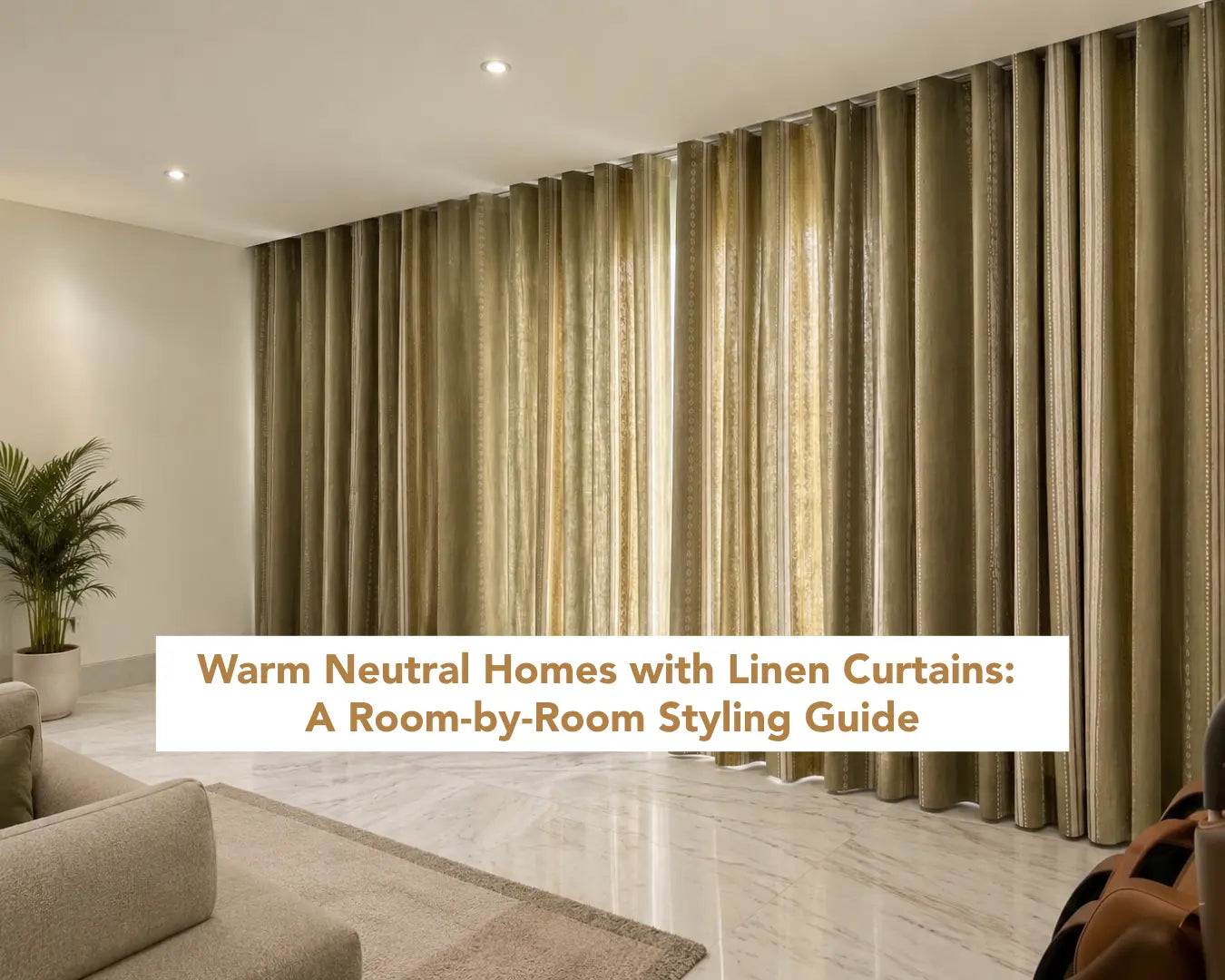
Floor length curtains are the most versatile option for many living rooms, bedrooms and full-height openings. They create a continuous vertical line from the rod or track to the floor, which makes the room feel taller and more finished. They also frame windows and doors properly, instead of making them look visually disconnected from the rest of the wall.
This is one reason floor length curtains work across different interior styles. They can look simple and understated in solid cotton, softer in sheers, expressive in printed designs and richer in textured linen or cotton-linen curtains. They also suit layered window treatments, where a sheer curtain is paired with a room-darkening curtain for privacy, light control and depth.
-
A slight float means the curtain hem clears the floor by a small margin. This is usually the most practical option for everyday Indian homes. It works well in busy rooms, homes with pets, regular sweeping and mopping, and spaces where a robot vacuum is used.
-
A floor kiss means the curtain lightly touches the floor. This gives a sharper, more tailored appearance, provided the rod, track and floor are level. It looks precise, but it also requires more accurate measurement.
For many homes, floor length curtains offer the best balance between design and function. Premium natural fabrics such as cotton and linen add texture, movement and a relaxed elegance without making the room look overly formal.
4. Puddle-Length Curtains

Puddle-length curtains include extra fabric that gathers on the floor. They can look soft, romantic and decorative, especially in large bedrooms, formal living rooms or spaces where the curtains are meant to be more visual than functional.
This style can work beautifully with fluid natural fabrics because the extra length falls more gently. It also adds softness to a room that has large furniture, hard flooring or a more formal layout.
However, puddle curtains need more care. The fabric gathers dust easily, must be rearranged after cleaning and may obstruct walking routes. It is also less practical for balcony doors, sliding doors or curtains that are opened and closed many times a day. Homes with pets or young children may find puddling difficult to maintain.
The Yellow Dwelling’s own product guidance notes that a customer can add extra length when they intentionally want a puddled effect. The brand also offers standard long door curtain sizing and customisation where standard sizes do not fit the space correctly.
Are Floor Length Curtains the Best Choice for Windows?

For many windows, yes. Floor length curtains are a strong choice when the window has clear wall space below it and the homeowner wants the room to look taller, calmer and more complete.
They work especially well when several windows or doors sit along the same wall. Using the same curtain length across them creates visual consistency. This is useful in living rooms, bedrooms and dining spaces where the curtain is part of the overall room composition, not just a window covering.
Floor length curtains also help when privacy or room darkening is important. Longer panels cover more wall height and feel more secure, especially when paired with lining or layered with sheers.
However, the window size alone should not decide the curtain length. The more useful question is: what is happening beneath the window?
If a desk, counter, storage unit or built-in seating sits below it, a shorter curtain or Roman blind may be more practical. If the window is close to a wet or high-spill area, keeping fabric away from the floor is sensible. If there is not enough wall space for the curtain to stack neatly, a blind may again be the cleaner option.
What Length Works Best for Balcony and Full-Height Doors?

Balcony doors, sliding doors, French doors and tall glazed openings usually look best with long curtains for doors. Short curtains can interrupt the height of the opening and make the space feel visually cut off.
For frequently used doors, a slight float is usually the most practical finish. The curtain clears the floor just enough to avoid catching underfoot, brushing balcony dust or getting dragged into sliding tracks. It also makes daily sweeping and mopping easier, which matters in Indian homes where balcony doors are often opened for ventilation, plants, laundry access or outdoor seating.
A floor kiss can work for a door that is not opened constantly, such as a bedroom French door or a formal living room opening. Puddling, however, is generally inconvenient in a doorway because the extra fabric can block movement and need constant adjustment.
Stacking width is another important detail. Long door curtains should move fully to the side without blocking the active doorway, handle or track. This is especially important for sliding doors, where the usable opening can already be limited.
The Yellow Dwelling offers standard curtain sizes for windows, doors and long doors, including long-door options commonly listed at 108 inches in product sizing. Some product pages also mention that the standard long door curtain fits a door up to 8 feet high, while customisation is available for non-standard openings.
The Curtain-Length Decision Test
Use this quick decision test before finalising the length.
-
Is there anything below the window?
If there is a counter, desk, cabinet, seating ledge or storage unit below the window, avoid forcing a full-length curtain. Sill length, apron length or a Roman blind may work better.
-
Is it a frequently used door?
For balcony doors and sliding doors, choose long curtains for doors with slight floor clearance. This keeps the hem away from tracks, dust and daily foot movement.
-
How often is the floor cleaned?
If the room is swept, mopped or vacuumed often, a slight float is easier to maintain than a floor kiss or puddle.
-
Are there children or pets?
Avoid excessive fabric resting on the floor. A clean floor-length finish with a slight float is usually safer and easier to manage.
-
Is the room formal or everyday?
A floor kiss or puddle can suit formal rooms where the curtains are mostly decorative. Everyday rooms usually work better with a slight float.
-
Do you want the room to appear taller?
Choose floor length curtains and hang them higher than the window frame where possible. This creates a stronger vertical line and makes the room feel more balanced.
Why Fabric Changes the Way a Curtain Length Looks
The same measured length can look different depending on the fabric. A light cotton sheer may fall softly and move with the breeze, while a lined room-darkening curtain may appear fuller and more structured. Header style, weave, lining and fullness also affect how the curtain sits once installed.
Cotton curtains create a comfortable and versatile fall. They suit bedrooms, living rooms and informal spaces because they feel soft without looking too heavy. Linen and cotton-linen textures bring natural movement and visual depth, especially in full-length panels. Sheer natural fabrics feel airy when used from a higher rod or track, while lined panels need more accurate clearance because they carry more weight at the hem.
This is where The Yellow Dwelling’s fabric positioning fits naturally. The brand offers premium natural fabric curtains, including cotton curtains and selected cotton-linen options. Its long door curtains collection includes 100% premium BCI-certified cotton curtains and cotton-linen blend curtains.
Natural fabric curtains also support the brand’s eco-friendly material approach. However, the right expectation matters. Natural fabrics should not be described as automatically dust-proof, stain-proof or maintenance-free. Their strength lies in their texture, comfort, breathability and organic fall.
Measuring Mistakes That Can Ruin the Final Length
Curtain length problems usually begin before the fabric is even selected. A beautiful curtain can still look wrong if the measurement is taken casually.
-
One common mistake is measuring before deciding the rod or track height. The final hanging point determines the drop, not just the window or door frame.
-
Another mistake is measuring only one side. Floors can slope slightly, especially in older homes or near balcony areas, so it is better to check the left, centre and right.
Header and hardware also matter. Eyelets, rings, pleats and tracks do not suspend fabric from the exact same point. A curtain measured for one header style may not fall the same way with another.
Choosing a standard size only from ceiling height can also be misleading. Two rooms with the same ceiling height may need different curtain lengths depending on rod placement, flooring, thresholds and how high the opening sits.
The finished floor level should be considered too. Measure after flooring, raised thresholds or fixed rugs are in place. Also think about how the curtain will be used. A perfect floor kiss may look lovely when closed but become inconvenient if the curtain is tied back or opened several times daily.
The Yellow Dwelling recommends measuring from the rod to the floor for door curtains, and its size guidance includes standard window, door and long-door options. Its website also mentions customisation for preferred length, header style and lining options.
Standard Size or Custom Length: Which Should You Choose?

A standard curtain can work well when the rod is already installed at a compatible height, the floor is level and the required finish closely matches an available size. It may also work when minor hemming is acceptable or when the curtain is being used in a casual space.
Custom length is better when precision affects the final appearance. This includes unusually tall or wide openings, multiple doors and windows along one wall, uneven flooring, layered curtains or rooms where the homeowner wants an exact floor kiss.
Customisation is not only for large homes. Even a compact apartment can benefit from custom curtains if the rod height, furniture placement or floor level does not match a ready-made size.
The Yellow Dwelling offers standard window, door and long door curtains, along with customised curtains for spaces that need a more exact fit. Its FAQ page also mentions customisation in preferred length, header style and lining options.
Get the Length Right With an Expert Home Visit

When curtain length feels confusing, an Expert Home Visit can make the process easier. Instead of guessing the right drop, header style or fabric fall, homeowners can get the space measured professionally and see fabric options in their own interiors.
The Yellow Dwelling’s Expert Home Visit includes in-home curtain and Roman blind measurements, access to cotton and linen fabric options, design recommendations suited to the interiors, guidance on tracks and fittings, and a detailed estimate. The service is listed at a nominal booking fee of ₹449.
This is especially useful for long curtains for doors, layered window treatments, floor-to-ceiling curtains, corner windows or rooms where standard sizes do not quite match the space.
Book The Yellow Dwelling’s Expert Home Visit for ₹449 to compare premium natural fabrics, confirm the right curtain length and plan a made-for-your-space finish.
So, Are Floor Length Curtains the Best Choice?
Yes, floor length curtains are the best all-round choice for unobstructed living-room windows, bedroom windows, balcony doors and other tall openings. They create height, balance and a more complete frame around the opening.
For everyday homes, a slight float is usually the most practical finish. A floor kiss gives a sharper, tailored result when the measurements are precise. Sill and apron lengths work better around counters, furniture and restricted floor areas. Puddling should be selected for decorative effect, not by default.
In the end, curtain length should work with the room, not just the trend. A precisely measured curtain made from premium cotton or linen will usually look more intentional than a fashionable length chosen without considering the space.